


No, rainwater alone is not a reliable window-cleaning method because it can carry dust, pollen and airborne contaminants onto glass.
For Oldham properties, professional cleaning remains more dependable because purified water, suitable cleaning-equipment and controlled rinsing remove contaminants instead of simply adding more moisture.
Why is rainwater not enough to clean windows?
Rainwater can wet glass, but it does not provide a complete cleaning process because rainfall cannot reliably remove bonded dirt, dust, pollen, bird deposits or residue from window surfaces. Professional cleaning combines agitation, rinsing and appropriate water quality to achieve a consistently clear finish.
Rainwater is often mistaken for naturally distilled water. Although rain begins as atmospheric moisture, droplets interact with airborne particles and gases before reaching a window. Once rainfall lands on a dirty frame or pane, it can loosen some surface contamination, but that does not mean the glass has been cleaned.
Oldham properties are exposed to changing weather conditions throughout the year. Rain can mix with dust, pollen, traffic particles and organic debris already present on glass. When the water evaporates, remaining contaminants can become more noticeable.
The key distinction is between rinsing and cleaning. Rain provides uncontrolled rinsing without mechanical agitation or targeted removal of grime. A professional window cleaning process deliberately loosens contamination before thoroughly rinsing the surface.
This matters particularly for windows that have not been maintained for several weeks. Accumulated deposits can bond more strongly to glass, frames and sills. Rainfall may soften the surface layer without removing the underlying contamination.
Can rain make windows dirty after they have been cleaned?
Rain does not automatically make professionally cleaned windows dirty, but rainfall can expose remaining contamination on glass, frames and sills. Clean glass can still become dirty after rain when airborne particles, pollen or debris are deposited onto the wet surface and later dry.
The common belief that rain itself always makes windows dirty is too simple. Clean glass can tolerate rainfall without immediately developing stains. The greater issue is what the rain encounters before and after it reaches the glass.
Dirty window frames are particularly important. Water can run through accumulated dust, algae and organic material around the frame before reaching the glass. This can create new marks even when the centre of the pane was previously cleaned.
Rain can also move contaminants across the surface rather than completely removing them. During light rainfall, droplets may spread existing dust into thin films. Once the surface dries, those films become visible as patches or streaks.
Professional window cleaning therefore focuses on the complete glass area and surrounding framework. Removing contamination from frames and sills reduces the amount of material that rainfall can carry back onto the pane.
Bee Cleaning Services Manchester’s existing window-cleaning guidance also highlights the importance of regular maintenance because rainfall and local environmental conditions can accelerate exterior grime accumulation.
What is the difference between rainwater and pure water for window cleaning?

Rainwater and purified window-cleaning water are not the same. Professional pure-water systems deliberately remove dissolved minerals and impurities before application, allowing the water to rinse glass without introducing the mineral residue associated with untreated water.
Pure water used in professional window cleaning is produced through filtration processes such as reverse osmosis and deionisation. These systems reduce dissolved solids and minerals in the water. A TDS meter can then be used to monitor the water quality.
This is important when a water-fed pole system is used. The cleaning brush agitates dirt while purified water carries loosened contamination away. The glass can then dry naturally without the same mineral deposits that untreated water may leave behind.
Rainwater does not provide this level of controlled purity. Its composition changes according to atmospheric conditions and the particles it encounters during rainfall. It is therefore unsuitable as a controlled substitute for professionally prepared pure water.
Professional pure-water cleaning also provides consistency. The operator knows what water quality is being applied to the glass rather than relying on unpredictable weather conditions. That consistency is one reason purified water is widely used in modern exterior window cleaning.
Why does cleaning-equipment matter when cleaning windows?
The right cleaning-equipment determines how effectively dirt is loosened, rinsed and removed from glass. Water-fed poles, soft brushes, purified-water systems, squeegees and clean microfibre materials each serve different purposes, while worn or unsuitable tools can create streaks.
A water-fed pole system is particularly useful for exterior windows because it allows operators to work from ground level on many properties. Purified water travels through the pole to a brush head, where the brush agitates dirt before the glass is thoroughly rinsed.
Traditional cleaning equipment still has an important role. Squeegees can remove cleaning solution and water from interior glass effectively. Microfibre cloths can also help detail edges, frames and areas requiring controlled drying.
Equipment condition matters as much as equipment selection. A worn squeegee blade can leave lines across the glass. A dirty cloth can transfer particles from one surface to another. A contaminated brush can also reduce the quality of the final rinse.
Professional window cleaning therefore involves more than choosing a bucket of water. The operator must match the equipment and technique to the glass, height, accessibility and contamination level.
Bee Cleaning Services Manchester’s published guidance similarly identifies purified-water systems, water-fed poles, commercial-grade squeegees and microfibre materials as important components of consistent window-cleaning results.
Is rainwater reliable for window cleaning in Oldham?
Rainwater is not reliable enough to replace professional window cleaning in Oldham because rainfall is unpredictable and cannot control water purity, cleaning pressure, agitation or contamination removal. A planned cleaning schedule provides a more consistent result regardless of changing weather.
Oldham’s weather can change quickly between dry periods, showers, cloud and stronger winds. Current Met Office forecasts for Oldham demonstrate how precipitation, humidity and wind conditions can vary over short periods.
Weather also affects how quickly contaminants accumulate. Rain can wash particles from roofs, frames and nearby surfaces onto glass. Wind can transport dust and organic material onto previously cleaned panes.
This does not mean professional window cleaning should stop whenever rain is forecast. The suitability of the weather depends on the intensity of rainfall, wind conditions, temperature, access requirements and the cleaning method being used.
A professional operator can assess these conditions before starting work. This is different from waiting for rain to perform the cleaning naturally. Rainfall provides no guarantee that every pane, frame, sill and edge will receive adequate attention.
For properties exposed to frequent rainfall, a regular maintenance schedule is therefore more practical than relying on weather. Bee Cleaning Services Manchester’s Oldham window-cleaning guidance recommends regular exterior maintenance because local rainfall and environmental contamination contribute to recurring dirt accumulation.
How does pure-water window cleaning work?
Pure-water window cleaning uses filtered water and specialist equipment to loosen contamination from glass and frames before rinsing the surface thoroughly. Because dissolved minerals are greatly reduced, the water can dry naturally with less risk of mineral spotting.
The process normally begins with preparation of the water supply. Professional systems use filtration to reduce minerals and other dissolved solids. The resulting water is delivered through a hose connected to a telescopic water-fed pole.
A soft brush is moved across the window surface to agitate dirt. The operator pays attention to glass, frames, seals and sills because contamination around these areas can affect the final appearance.
The glass is then rinsed with purified water. The purpose of this stage is to carry loosened dirt and remaining particles away from the surface rather than simply spreading them across the pane.
After rinsing, the remaining purified water can dry naturally. Since the water contains far fewer dissolved minerals than ordinary untreated water, there is less mineral residue left behind.
This method is particularly useful for upper-storey windows because many properties can be cleaned from ground level. It can therefore reduce the need for ladders while maintaining access to difficult exterior glass.
Should homeowners rely on rainwater between professional window cleans?
Homeowners can allow normal rainfall to rinse exterior glass between cleaning appointments, but rain should be viewed as weather exposure rather than a substitute for cleaning. Regular professional washing remains necessary to remove accumulated dirt, organic matter, residue and contaminants.
Rain can provide a temporary rinse, especially when glass is already relatively clean. It may remove loose dust from exposed surfaces. However, it cannot target specific deposits or guarantee that frames and sills are free from contamination.
The problem becomes more obvious on properties near busy roads, trees or areas with significant airborne debris. Pollen, traffic residue, bird deposits and organic material can accumulate despite repeated rainfall.
A regular cleaning schedule prevents these materials from becoming increasingly difficult to remove. Bee Cleaning Services Manchester’s published Oldham guidance suggests that many residential properties benefit from exterior cleaning approximately every four to eight weeks, with local exposure influencing the exact interval.
The correct frequency should therefore reflect the property rather than rainfall alone. A sheltered home may need less frequent attention than a property beside a busy road or beneath mature trees.
The practical rule is simple: rain can rinse, but it cannot replace controlled cleaning. Professional maintenance provides the predictable removal process that rainfall cannot deliver.
When should Oldham homeowners choose professional window cleaning?
Professional window cleaning becomes the better option when windows have visible streaks, mineral deposits, organic contamination, difficult access or recurring dirt that rainfall does not remove. The appropriate service should match property height, glass condition, accessibility and maintenance frequency.
Ground-floor windows may be relatively easy for homeowners to clean. Upper-storey panes create additional access and safety considerations. A water-fed pole system can provide a safer alternative for many external windows.
Heavy contamination also changes the cleaning requirement. Long-standing deposits may require more than a quick rinse. Frames and sills may need additional agitation before the glass receives its final rinse.
The quality of the result should also be considered. A low-cost cleaning method that leaves residue may require repeated cleaning and reduce the value of the appointment. Professional equipment can improve consistency across larger numbers of windows.
For homeowners comparing local options, professional window cleaning solutions for clearer glass can be evaluated alongside the cleaning method, equipment and maintenance frequency offered. The Bee Cleaning Services Manchester website identifies Window Cleaning among its available cleaning services and lists Oldham among its coverage areas.
How should you choose between traditional and pure-water window cleaning?
Choose the cleaning method according to access, glass condition, building height and desired finish. Traditional squeegee cleaning suits many accessible windows, while pure-water water-fed pole cleaning is particularly useful for exterior and elevated glass where safe ground-level reach is advantageous.
Traditional cleaning uses a washer or applicator, cleaning solution and squeegee. It provides precise control and is effective for many interior windows and accessible exterior panes.
Pure-water cleaning follows a different process. The brush agitates the glass and frames while purified water continuously rinses away loosened contamination. The surface can then dry naturally.
For multi-storey properties, the water-fed pole method offers a significant operational advantage. Operators can often clean elevated windows without standing directly beside the glass on a ladder.
The choice should also consider the condition of the glass. Existing mineral deposits or construction residue may require specialist treatment rather than routine maintenance cleaning.
A professional assessment is therefore more useful than choosing a method solely because it is advertised as newer or cheaper. The correct approach depends on the property and the condition of the windows.
What should a regular Oldham window-cleaning schedule include?
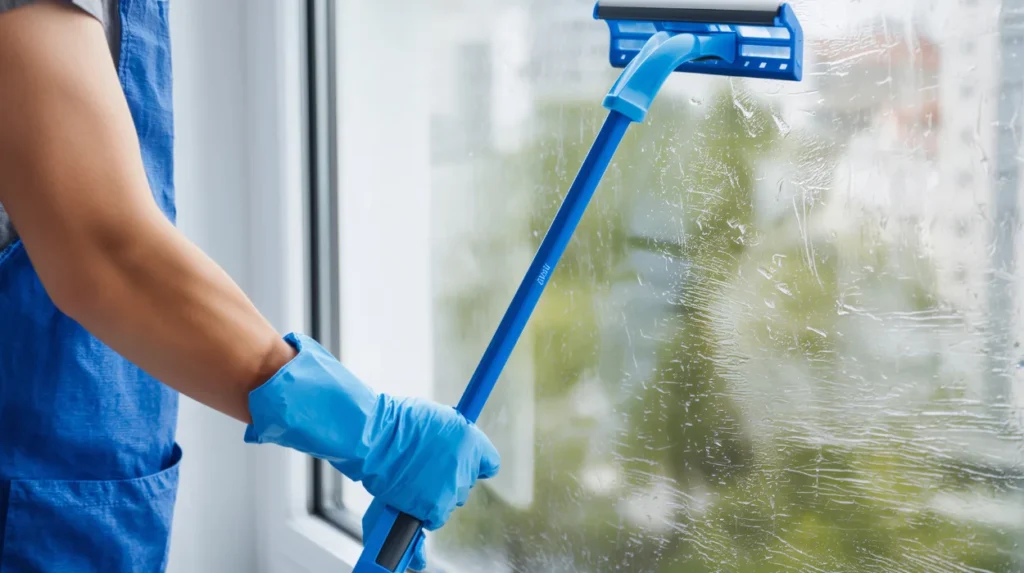
A practical window-cleaning schedule should consider exterior glass, frames, sills, accessibility, local contamination and seasonal conditions. Residential properties often benefit from four-to-eight-week exterior intervals, while exposed or commercial properties may need more frequent maintenance.
Spring can bring pollen and organic debris. Summer may increase dust and allow contaminants to dry quickly onto glass. Autumn introduces leaves and damp organic material around frames and sills.
Winter can bring rain, wind and road-related debris. These contaminants can accumulate around lower windows and frame drainage areas.
A maintenance plan should therefore cover more than the visible centre of the glass. Frames, edges and sills should also be considered because they can hold contamination that later transfers back onto clean panes.
Properties beside busy roads, under trees or in high-traffic areas may need shorter cleaning intervals. Less exposed properties may maintain acceptable results for longer.
The objective is consistency rather than waiting until windows become visibly dirty. Regular cleaning keeps contamination easier to remove and maintains a clearer appearance throughout the year.
What is the final answer about rainwater window cleaning?
Rainwater is useful as natural moisture and may rinse loose surface dust, but it is not good enough to replace proper window cleaning. In Oldham, controlled cleaning with suitable equipment and purified water provides a more reliable approach to removing dirt and maintaining clear glass.
The important distinction is between water arriving naturally and water being used deliberately as part of a cleaning system. Rain cannot control pressure, agitation, water purity or coverage.
Pure-water systems address these variables systematically. The water quality is controlled, the brush agitates contamination, and the final rinse removes loosened material from the glass.
Rain also interacts with the existing condition of a window. If frames and glass are already dirty, rainfall can move contamination across the surface rather than eliminate it.
For Oldham homeowners, the practical solution is to maintain a regular cleaning schedule and treat rainfall as normal weather rather than a cleaning method. This produces more predictable results across changing seasons.
Bee Cleaning Services Manchester provides professional cleaning solutions for properties that require controlled exterior window maintenance, appropriate cleaning-equipment and a consistent approach to glass care.
FAQs About Rainwater and Window Cleaning
Is rainwater actually good for cleaning windows?
Rainwater can rinse loose dust from windows, but it is not a complete cleaning method.
It does not provide controlled brushing or agitation to remove stuck-on dirt.
Rain can also collect contaminants from frames, roofs and surrounding surfaces.
Professional cleaning uses controlled water quality and suitable cleaning-equipment.
For consistently clear windows, rain should not replace scheduled cleaning.Can professional window cleaners clean windows when it is raining?
Yes, light rain does not necessarily prevent professional window cleaning.
Water-fed pole systems use purified water to clean and rinse the glass.
The cleaning result depends more on technique, contamination and weather conditions.
Heavy rain and strong winds can make exterior work impractical or unsafe.
A professional cleaner can assess conditions before starting the service.Why does pure water not leave spots on windows?
Pure water has most dissolved minerals removed through specialist filtration.
This reduces the mineral residue that can create spots when water dries.
A water-fed pole brush agitates dirt before the glass is thoroughly rinsed.
Correct rinsing is essential because dirty water can still leave marks.
The method is widely used for exterior and high-level window cleaning.Is rainwater the same as pure water used by window cleaners?
No, collected rainwater and professionally purified water are not automatically equivalent.
Rain can collect particles when it passes through the atmosphere and building surfaces.Does rain make freshly cleaned windows dirty?
Rain does not automatically make freshly cleaned glass dirty.
The problem is usually contamination already present on frames, sills or surrounding surfaces.
Rainwater can carry that material onto the glass as it runs downward.
Wind can also deposit dust, pollen and other particles after cleaning.
Regular professional cleaning helps minimise this recurring contamination.