

Commercial cleaners should hold verifiable certifications covering health and safety, COSHH compliance, infection control, and recognized industry training programs. These credentials confirm that a cleaning provider operates within UK legal requirements and delivers consistent, safe, and professionally accountable results for business clients.
Why Certification Matters in Commercial Cleaning
When a business invites a cleaning team onto its premises, it is trusting that team with its physical environment, the wellbeing of its staff, and in many cases, compliance with sector-specific regulations. Certifications provide documented proof that a commercial cleaner has been trained, assessed, and approved to operate in professional settings. Without them, there is no reliable way to verify whether cleaning products are used safely, whether staff are adequately trained, or whether results meet the standards expected in regulated workplaces.
For businesses operating in sectors such as healthcare, food production, education, or finance, the stakes are considerably higher, because regulatory bodies routinely require documented evidence of contractor qualifications. A cleaning company without certifications is a liability, not simply a cost-saving option. Choosing certified providers protects a business from health risks, legal challenges, and reputational damage that can otherwise go unnoticed until a problem surfaces.
COSHH Compliance and Chemical Safety Training
COSHH stands for Control of Substances Hazardous to Health, and it represents one of the most fundamental regulatory requirements for any contractor working with cleaning chemicals in the UK. Every professional cleaning company should ensure its staff have completed COSHH training, which covers the correct identification, storage, handling, and disposal of hazardous substances used in daily cleaning operations. This is not simply a best practice recommendation but a legal obligation governed by UK health and safety legislation that applies to all cleaning contractors regardless of company size.
Staff who lack COSHH training may inadvertently mix incompatible products, apply incorrect concentrations, or dispose of substances in ways that create environmental and occupational hazards. For businesses considering Commercial Cleaning Services in Farnworth, confirming that cleaning operatives hold up-to-date COSHH compliance records is a non-negotiable step in any proper supplier vetting process. Reputable providers will have COSHH risk assessments documented for every product used on client premises and will produce this documentation on request without hesitation.
Health and Safety Qualifications Every Commercial Cleaner Should Hold

Health and safety qualifications in the commercial cleaning sector go well beyond knowing how to avoid a slip hazard or store a mop correctly. They encompass a broader working knowledge of risk assessment, manual handling, working at height, personal protective equipment, and emergency procedures relevant to the cleaning environment. The two most widely recognized health and safety qualifications in the UK cleaning industry are IOSH and NEBOSH, each serving a distinct function within a professionally structured cleaning organization. IOSH, delivered by the Institution of Occupational Safety and Health, offers the Working Safely and Managing Safely courses, which are broadly accepted as baseline qualifications for operatives and supervisory staff.
NEBOSH, the National Examination Board in Occupational Safety and Health, provides more in-depth qualifications suited to managers overseeing cleaning operations across multiple commercial sites. At minimum, individual cleaning operatives should hold IOSH Working Safely certification, while supervisors and team leaders should be qualified to IOSH Managing Safely standard or an equivalent level. Businesses hiring external cleaning contractors should request copies of these certificates before any contract is formally signed.
IOSH and NEBOSH: Understanding the Difference
IOSH qualifications are shorter, more accessible, and specifically designed for operational staff who need a practical understanding of safety in their everyday roles on site. NEBOSH qualifications require a greater time commitment and are structured for individuals in management or health and safety advisory roles within a cleaning organization. Both qualifications carry real weight when assessing a cleaning provider’s commitment to safety, and together they indicate a company that takes staff development seriously at every level.
A cleaning organization that invests in NEBOSH-qualified management demonstrates a professional attitude toward workplace safety that goes beyond the minimum required by law. For business owners reviewing potential cleaning contractors, the presence of both IOSH-trained operatives and NEBOSH-qualified managers is a reliable indicator of a structured, professionally managed operation. This layered approach to qualification reflects the kind of organizational maturity that business clients should actively look for when comparing providers.
British Institute of Cleaning Science Accreditation
The British Institute of Cleaning Science, widely known as BICSc, is the largest independent, not-for-profit membership and awarding body in the UK cleaning and support services industry. BICSc accreditation confirms that a cleaning company’s staff have been formally trained and assessed against nationally recognized standards covering a wide range of cleaning methods, equipment use, and surface care procedures. The BICSc Cleaning Operatives Proficiency Certificate is particularly valued in the industry because it demonstrates that individual operatives can perform specific tasks to a certified standard, rather than simply claiming general experience.
For client businesses, choosing a BICSc-accredited cleaning provider means receiving a structured service built around measurable outcomes and quality benchmarks that can be referenced in service level agreements. Bee Cleaning Services Manchester recognizes the importance of working within recognized professional frameworks and aligns its service delivery with established industry standards to give clients confidence in the quality they receive. Businesses looking for professional commercial cleaning solutions in Farnworth should look for providers who hold BICSc membership or comparable accreditation as part of their documented qualification profile.
ISO 9001 and Quality Management Standards
ISO 9001 is an internationally recognized standard for quality management systems, and its presence within a cleaning company’s credentials signals a deeper commitment to structured, repeatable, and auditable service delivery across all client environments. Achieving ISO 9001 certification requires a business to document its processes, standardize its procedures, and conduct regular internal audits to maintain and continuously improve the quality of its operations.
For a cleaning provider, this means clients can realistically expect the same quality of service regardless of which operative attends on a given day or which site is being cleaned. ISO 9001 also requires businesses to have formal client satisfaction monitoring in place, which means that feedback is actively collected, reviewed, and used to drive measurable service improvements over time. While not every commercial cleaning company achieves ISO 9001 certification, its presence is a meaningful differentiator that distinguishes professionally managed operations from informal service providers. For businesses conducting supplier assessments, ISO 9001 is one of the clearest organizational signals that a cleaning company takes quality seriously at a strategic level.
Safe Contractor Approval and Vetting Schemes
Safe Contractor is one of the most widely used contractor vetting schemes in the UK, and its approval process independently assesses a cleaning company’s health and safety competence, insurance coverage, and overall regulatory compliance. A Safe Contractor approved cleaning business has been reviewed against an established set of criteria and has demonstrated that it meets the standards required to operate as a compliant, low-risk contractor across a range of commercial environments. This third-party approval process gives client businesses a clear and independently verified signal that engaging a particular cleaning company will not create unmanaged liability or compliance exposure.
Other recognized schemes operating across the UK include CHAS (Contractors Health and Safety Assessment Scheme) and Constructionline, both of which carry equivalent credibility within the cleaning sector. Businesses that operate their own supply chain compliance programs will frequently require Safe Contractor or CHAS approval before any cleaning contract can be awarded or renewed. Checking for these approvals is a practical, low-effort way for any business to verify contractor credibility without commissioning independent audits or lengthy due diligence processes.
DBS Checks and Staff Vetting in Commercial Environments
Beyond technical qualifications, the individual vetting of cleaning staff is equally important for businesses operating in sensitive or regulated environments where unauthorized access could have serious consequences. A Disclosure and Barring Service check, commonly known as a DBS check, provides a documented record of any criminal convictions or cautions that might be relevant to an individual’s suitability for working in particular environments. In settings such as schools, care facilities, medical practices, or financial services offices, DBS checks are often mandatory for any individual granted regular access to the premises, regardless of whether they are directly employed or subcontracted.
Reputable commercial cleaning companies will conduct DBS checks on all staff as a standard element of their recruitment process rather than only when a specific client raises the requirement. Bee Cleaning Services Manchester understands that trustworthy access to client premises depends on thorough and documented staff vetting as a baseline standard across all types of commercial cleaning work. Clients should always confirm a provider’s DBS policy in writing before cleaning staff are given unsupervised or out-of-hours access to any part of their building.
Industry-Specific Standards for Specialist Environments
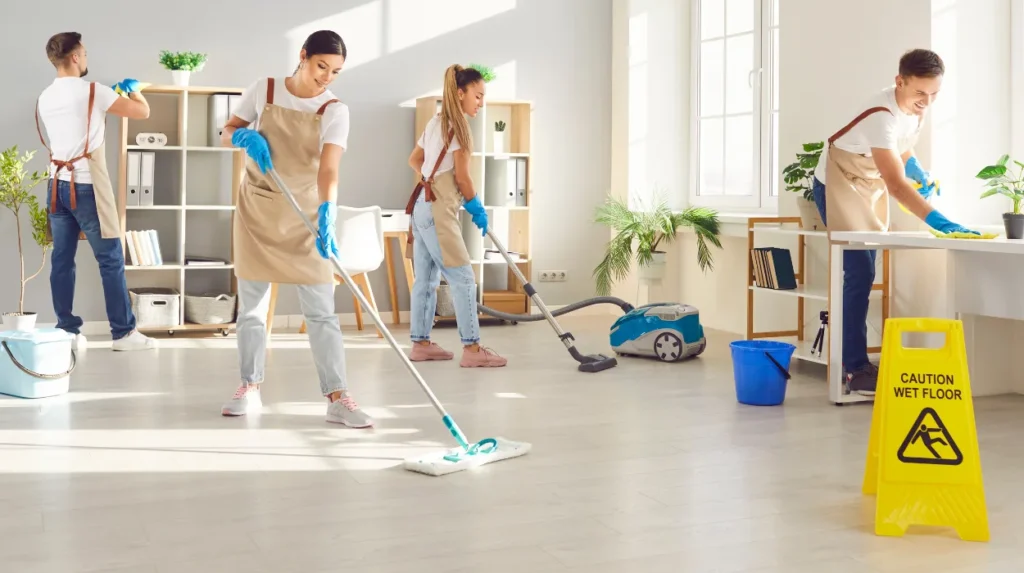
Some commercial environments carry cleaning requirements that go significantly beyond the scope of general health and safety qualifications, making sector-specific training an important additional consideration for businesses in regulated industries. In healthcare settings, cleaning staff may need to demonstrate knowledge of infection prevention and control protocols, decontamination procedures, and the correct application of clinical-grade disinfectants at appropriate contact times and concentrations. The NHS National Specifications for Cleanliness provides a recognized benchmarking framework that cleaning providers working in or adjacent to healthcare environments should understand, even when they are not directly contracted by NHS organizations.
In food production and hospitality settings, cleaning operatives should hold relevant food hygiene awareness training and understand how allergen cross-contamination risks relate to surface cleaning and equipment sanitation. For anyone researching the key questions to ask when choosing a commercial cleaner, understanding whether a provider holds environment-specific certifications is one of the most frequently overlooked areas of proper contractor evaluation. Aligning the certification profile of a cleaning company with the actual operational requirements of a specific commercial environment is the most reliable method for ensuring appropriate and compliant service delivery.
What These Certifications Mean for Your Business
Selecting a certified cleaning contractor is ultimately an exercise in risk management, protecting your business operations, your staff, and your ongoing compliance obligations from avoidable incidents and legal exposure. A cleaning company with documented qualifications, approved contractor status, and transparent staff vetting procedures removes a significant layer of uncertainty from the cleaning relationship and establishes a foundation for consistent and accountable service delivery over time. Businesses that overlook certification requirements during supplier selection often encounter service quality failures, health and safety incidents, or regulatory compliance issues that could have been avoided through straightforward pre-contract due diligence.
Requesting evidence of certifications before signing a cleaning contract requires little time but provides meaningful protection against risks that can be both costly and disruptive to manage after the fact. For any business in the Greater Manchester area, including those evaluating Commercial Cleaning Services in Farnworth, treating certification verification as a standard step in the procurement process is the most practical form of assurance available. When a provider cannot produce clear documentation of its qualifications and vetting procedures, that absence is itself an informative signal about the operational standards it applies across all its client relationships.
Understanding the professional certifications and standards that define quality commercial cleaning gives businesses the tools to make well-informed decisions about the contractors they bring into their working environments. From COSHH compliance and IOSH health and safety qualifications through to BICSc accreditation, ISO 9001 certification, and Safe Contractor approval, each credential adds a verifiable layer of accountability and professional competence to a cleaning operation.
For businesses ready to take the next step in securing a qualified and reliable cleaning partner, exploring reliable commercial cleaning support for your Farnworth business provides a practical starting point for businesses that want professional, standards-driven service delivery. Bee Cleaning Services Manchester provides commercial cleaning solutions that are grounded in professional standards, transparent staff accountability, and a consistent approach to service quality across all client environments and industry sectors.
What is a commercial grade cleaner?
A commercial grade cleaner is a professional-strength cleaning product formulated for use in business environments. These products meet specific efficacy and safety standards, and certified commercial cleaners are trained through qualifications like COSHH to handle, dilute, and apply them correctly and safely.
What are the four categories of cleaners?
The four categories of cleaners are detergents, degreasers, abrasives, and acids. Certified commercial cleaning professionals understand which category suits each surface or environment, ensuring effective results without causing damage or creating health risks that proper training standards and COSHH compliance are specifically designed to prevent.
What is the 3 second rule for cleaning?
The 3 second rule refers to the brief visual inspection a cleaner performs after completing a task to confirm no residue, streaks, or missed areas remain. Professionally trained cleaners, working under recognized standards, apply this habit consistently to maintain verifiable quality across every commercial cleaning assignment.
What are the 7 rules of housekeeping?
The 7 rules of housekeeping cover sorting, setting in order, shining, standardizing, sustaining, safety, and service. Professional commercial cleaners trained under BICSc accreditation and industry standards apply these principles systematically, ensuring workplace environments remain clean, organized, compliant, and consistently maintained to an auditable professional standard.
What is R1, R2, R3, R4, R5 in housekeeping?
R1 to R5 is a housekeeping risk-rating system classifying cleanliness levels from very high risk to low risk environments. Certified commercial cleaners use this framework to apply appropriate cleaning protocols, products, and frequencies, ensuring each area receives treatment matched to its specific hygiene and compliance requirements.